Bar Staff for Hire Reading & Berkshire.
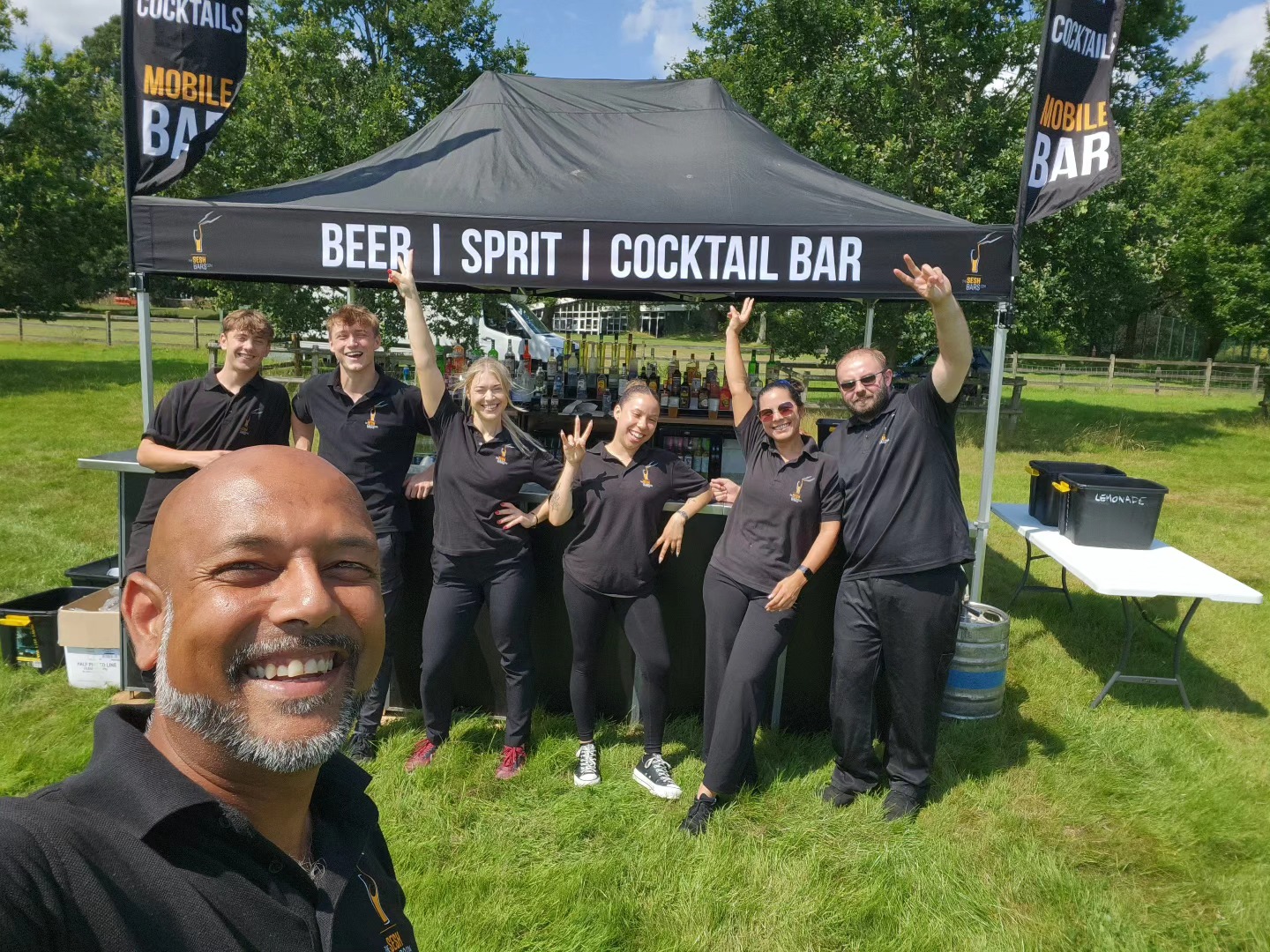
The Sesh Bars supply experienced bartenders and bar backs for events across Reading and Berkshire. Bar staff are quoted individually for your event. Our team carries £5m public liability insurance and arrives briefed on your event. Whether your venue has its own bar, you've dry-hired a mobile unit, or you need extra crew to support an existing team, we provide staff who arrive professional and ready to serve from the first order.
Availability
Check Your Date.
Tell us the date and rough guest count. We confirm availability and send a price within 24 hours.
Enquiry received
Thanks, we have your date.
We check availability by hand and reply within 24 hours. If your event is close, call 0118 449 3066 or message us on WhatsApp and we will answer faster.
Bar Staff Roles Available.
Bar staff hire covers three primary roles: head bartender, cocktail bartender, and bar back. Head bartenders manage the bar operation, stock, pacing, and team coordination, alongside serving. Cocktail bartenders focus on drink production, from classic serves to bespoke menus. Bar backs handle restocking, glass collection, ice runs, and bar hygiene so the bartenders never stop pouring.
Every staff member arrives pre-briefed on your event: guest count, drink list, dress code, venue layout, and any dietary or licensing considerations. We require a drinks list and event brief at least 48 hours before the event. For cocktail-heavy events, a tasting session can be arranged at your venue or our premises in advance.
Head Bartender
Bar management + serving, shift lead
Cocktail Bartender
Full menu capability, fast and accurate
Bar Back
Stock, glass, ice, keeps bar moving
What Bar Staff Hire Covers.
Every bar staff booking includes public liability insurance, pre-event briefing, smart event dress (black shirt, dark trousers, or as specified), and post-event closedown. Staff carry their own tools, shakers, jiggers, bar spoons, strainers, and speed pourers, so nothing is left to chance at the venue.
For events where you need the full package, bar unit, drinks, and staff together, see our mobile bar hire options or our professional bartender hire page for combined mobile bar and staff packages. Bar staff hire is also available as an add-on to any of our mobile bar packages if you need more hands on a busy night.
- Public liability insurance
- Pre-event briefing
- Event dress code
- Own bar tools
- Post-event closedown
- Licensing requirements checked for each event
- Flexible shift lengths
How Many Bar Staff To Hire.
The number of bar staff you need depends on guest count, drink complexity, and service window. Cocktail-heavy menus require more hands than beer-and-wine service. Below is our recommended staffing by event size: these ratios keep queue times under two minutes at peak service.
- Up to 50 guests
- 1 bartender + 1 bar back. Suitable for house parties, intimate receptions, and private dining.
- 50-100 guests
- 2 bartenders + 1 bar back. Standard for birthday parties, engagement parties, and mid-size corporate events.
- 100-200 guests
- 3 bartenders + 1-2 bar backs + head bartender. Required for weddings, product launches, and large private events.
- 200+ guests
- Full crew quoted per event. Multiple bar points, dedicated head bartender, and bar back team. Common at festivals and corporate galas.
Events We Staff Across Berkshire.
Bar staff hire serves a wide range of event formats: private parties at home or in hired venues, corporate receptions and product launches, wedding receptions where the couple has already contracted the venue bar, outdoor festivals and community events, and pop-ups. Minimum shift is four hours; events running beyond eight hours carry an overtime rate.
Venues across Reading, Berkshire and the Thames Valley often have their own bar infrastructure but lack the crew to operate it properly at high-volume events. Our staff integrate with venue teams or operate independently, whatever the event requires. That includes village halls, country houses, marquees, golf clubs, hotel function rooms and riverside venues on the Thames. Flexibility is built into every booking.
Need a professional bartender rather than a full bar crew? Bartender hire is for when you need a skilled mixologist, bar staff hire is for when you need a team. If your event also needs the physical bar unit, see our mobile bar hire packages. For wedding bar hire or dry hire setups, bar staff can be added as extra hands on a busy night.
Why Venues Hire Professionals.
Many event venues keep little or no permanent bar team. A full-time bartender is a significant year-round fixed cost, which is hard to justify for a venue running only a couple of events most weeks. The common fallback, casual hospitality workers or general catering staff pulled onto the bar, tends to produce uneven service, slower queues, and avoidable guest complaints. Professional bar staff hire solves this: venues and hosts get a bartender team matched to the event's size and complexity, only for the dates they need it.
Hiring by the shift costs a fraction of carrying permanent bar staff for occasional events. Outsourcing also moves staffing liability to an insured provider rather than the venue. For event planners, that is why bar staff are so often "venue-recommended": when a venue suggests a provider it has worked with before, it removes the guesswork of sourcing and vetting freelancers.
Bartender Background & Training.
The Sesh Bars bartenders are not part-time hospitality workers. They are trained bar professionals. Cocktail bartenders have specialised training covering both classic spirit-forward serves and contemporary craft techniques. Bar backs are trained in efficient glass management, stock rotation, and high-volume hygiene, preventing the common problem of understocked bars or, worse, dirty glassware at peak service. Head bartenders manage the team and the pace of service on larger events.
Licensing requirements are checked for each event, and we can arrange a Temporary Event Notice where required and agreed. Responsible service matters: bartenders should be able to identify underage drinkers and understand the legal implications of over-service, which protects both the event and the venue.
Bar Staff Availability & Booking Windows.
The event calendar creates predictable staffing bottlenecks. Understanding seasonal demand helps you book the crew you want at times that work for your event. Peak season (May-September) sees wedding and garden party peaks. Saturday availability fills 4-6 weeks ahead; mid-week slots remain open 2-3 weeks out. Friday and Sunday evenings typically book 2-4 weeks ahead even in peak season, offering flexible options for couples avoiding Saturday premiums. December (corporate Christmas parties) creates a second demand spike, bookings solidify 8-10 weeks ahead.
Off-peak (January-April, October-November) offers the most flexibility. We typically have crew available 2-3 weeks from your enquiry, and weekday timeslots often open within days. This flexibility makes off-peak ideal if your event date is set but needs to work around crew availability. Head bartenders and experienced bar backs are booked before entry-level staff. If you specifically need a senior bartender, add 1-2 weeks to typical lead times. Minimum shift is four hours; we can often accommodate shorter bookings (2-3 hours) with a surcharge. Short-notice bookings (under two weeks in peak season) carry a 15% surcharge but are still possible depending on crew calendars. Call 0118 449 3066 to check availability before committing to a date.
Bar Staff Hire Pricing.
Bar staff hire is quoted individually. The price depends on the number of staff required, the length of service, the location and the requirements of your event, and any travel charge is confirmed in your quote.
Head bartenders have a minimum of five years' professional bar experience across venues ranging from restaurants to nightclubs and event spaces. Our cocktail bartenders average 3+ years of specialised mixology training. Bar backs are trained in high-volume service, glass management, and stock rotation. This depth of expertise distinguishes professional hire from untrained venue staff or one-off freelancers: consistency under pressure, and guest-facing communication are built into every hire. Berkshire's event venues, from country houses and marquees to village halls and hotel function rooms, require staff who can adapt quickly. Our team's venue experience spans each setting, meaning staff arrive ready to work within your specific space and event flow. For events where you have a venue bar already in place but need additional hands to manage guest volume, bar staff hire, quoted individually for your event, provides professional mixologists without the full portable bar unit. This staffing flexibility is particularly valuable for venues during peak season (May-October) when demand spikes and freelance bartender availability drops, our pre-vetted, trained staff ensure consistent service quality regardless of how busy the events calendar gets.
Final quote depends on guest count, duration, drink complexity, and venue location. See our cost guide for budget examples or view all packages.
Professional Bar Staff Performance Standards.
Professional bartending has clear performance benchmarks. An experienced cocktail bartender works at these speeds: classic cocktails (stirred or shaken) produced in 60-90 seconds from order to serve; complex craft cocktails with multiple ingredients and techniques in 90-120 seconds; simple beer and wine service in 20-30 seconds per guest. Across a 4-hour event with 100 guests, this translates to service capacity: one bartender handles 40-60 cocktails per hour (assuming 60-90 second average production time), two bartenders manage 80-120 cocktails per hour. This mathematical reality determines staffing: a 100-guest event expecting 2-3 drinks per person (200-300 total drinks) across a 3-4 hour service window requires two bartenders minimum to maintain acceptable queue times (under 90 seconds at peak). Our bartenders arrive calibrated to this standard because they've trained in high-volume venues. Bartenders without professional backgrounds often work noticeably slower, creating guest perception of sluggish service even when staff are working full effort. In practice, professional bartenders sharply reduce peak-hour queue times compared with untrained venue staff, a critical differentiator for networking events where attendees expect fast, seamless bar service.
Good venues expect bartenders to keep quality consistent across high-volume service, making a Negroni at drink #50 with the same precision as drink #1. This consistency requires muscle memory (hundreds of repetitions), mental focus (tracking orders mentally during peak rushes), and drink knowledge (understanding spirit ratios, ice requirements, garnish choices by heart). When you hire The Sesh Bars staff, you're accessing bartenders with this pedigree: minimum 3 years professional bartending experience on cocktail bartenders, 5+ years on head bartenders. This investment in trained expertise prevents common failures at events: over-diluted cocktails (ice melt from poor technique), incorrect measures (spirits undersized, drinks taste weak), guest wait times exceeding 10 minutes (causing bar abandonment), or running short of critical ingredients mid-service. Common mistakes from untrained event staff include: failing to chill glassware before service (resulting in warm drinks), not pre-batching ingredients for high-volume orders (slowing service), ignoring ice management in warm weather (ice melt reduces drink quality), and poor stock rotation (running out of popular spirits while holding excess slow movers). Professional bar staff know these pitfalls and prevent them systematically. For corporate events where professional presentation and service speed directly impact attendee networking and satisfaction, fast, professional bar staff keep guests talking at the bar, which helps networking.
Staffing Needs by Event Type.
Different event types demand different bartender ratios and expertise levels. For a wedding, two bartenders plus a bar back is the standard for 80-100 guests because receptions require champagne service (demanding experienced staff), bespoke cocktail menu execution (needing skilled mixology), and smooth pacing through multiple service phases. With staff-only hire you are paying for the staffing expertise, not the equipment. For corporate events or product launches with 150+ guests and high-volume beer-and-wine service, the ratio drops to one bartender per 100 guests because beer and wine require less training than cocktails, one bartender + one bar back manages straightforward service efficiently. For intimate house parties (20-40 guests), one bartender suffices because guest volume is low and service windows are relaxed. The key calculation: peak-hour consumption divided by bartender capacity (60 drinks/hour per skilled bartender, 30-40 drinks/hour for basic beer-wine service) determines minimum staffing.
Varied event spaces create staffing complexity that generic freelancers cannot handle. Warehouse events demand bartenders who can operate independently, they've worked raw spaces where power is limited, water access requires planning, and bar setup is from scratch. Garden marquee events need staff trained in outdoor logistics: they understand how ice melts faster in summer heat, how wind affects glassware, and how to pace service when champagne needs to stay cold outside. Formal corporate events (hotel function rooms, private members' clubs) require bartenders trained in executive-level service: they're quick but invisible, they understand dress codes and professional conduct, and they can handle high-volume service during compressed time windows (drinks reception before dinner). Hiring bar staff without considering venue type often leads to mismatches: bartenders trained only in nightclubs don't understand the pacing required for wedding ceremonies; bartenders from traditional hotels struggle with warehouse logistics. Our team's venue diversity ensures you get staff pre-calibrated to your specific event space and service model.
Briefing & Communicating with Your Bar Staff.
Professional bar staff success depends entirely on pre-event communication. The difference between a smooth bar service and a chaotic one often comes down to whether the host and bartender team shared clear expectations in advance. The Sesh Bars requires detailed event briefings at least 48 hours before service. This is not optional and is standard practice for professional bar teams. This briefing covers: guest count and profile (are guests primarily industry professionals expecting fast cocktails, or a relaxed family gathering expecting beer and wine?), the final drinks list (cocktails, beer, wine, spirits, soft drinks, exactly which drinks will be ordered, and in what proportion), venue layout (where is the bar positioned, where are restrooms, where is the entry point, where do guests congregate), service windows (when does service start and end, are there key moments like toasts or champagne service), staffing ratios (how many bartenders and bar backs have been contracted), dress code (what are bartenders expected to wear, smart black tie, branded t-shirts, casual), and any special requirements (are there dietary restrictions bartenders need to know about, accessibility requirements, allergy warnings on drinks).
During the briefing, hosts and bartenders discuss guest dynamics: are guests likely to order one drink and nurse it, or order multiple rounds rapidly? Are there VIP guests or event hosts who should receive priority service? Will there be a signature cocktail introduction or tasting that bartenders need to be prepared for? Are there any cultural or religious considerations around alcohol service? Professional bartenders ask these questions because they genuinely change how service unfolds. A bartender expecting casual single-drink ordering arrives with a different pace than one preparing for high-volume peak service. If the event includes a VIP introduction or host speech, bartenders know to hold orders briefly during that window rather than create competing noise. If there are guests who don't drink alcohol, bartenders are pre-briefed on quality non-alcoholic options so they can offer alternatives without being asked.
Communication during the event itself follows established protocols that separate professional bar teams from disorganised crews. The head bartender manages all guest-facing communication: taking orders, confirming custom requests, managing guest expectations when bars are busy. Junior bartenders focus on drink production and do not take orders directly, this prevents confusion and duplicate orders. Bar backs handle stock, glass collection, and preparation, and they communicate with bartenders via physical signals and eye contact rather than calling out requests that would create noise. When a bartender needs ice, the bar back sees the empty ice bucket and refills it before being asked. This silent communication means guests never perceive shortage or scrambling, they just experience smooth service. If a bartender is unsure about a drink order or a guest's request, they communicate immediately with the head bartender rather than guessing, precision matters more than speed in professional service. Hosts notice this difference: bars where staff communicate clearly produce consistent drink quality, faster service during peak hours, and fewer guest complaints than bars where bartenders work independently without coordination.
Multi-Bartender Team Coordination.
Professional bar teams operate with silent communication protocols that distinguish high-performing crews from disorganised ones. When you hire multiple bartenders, the head bartender runs "call and repeat" - calling out orders loudly enough for the entire team to hear, with junior staff repeating back to confirm they've heard correctly. This prevents missed orders and distributes workload fluidly based on who has capacity. A skilled head bartender also manages drink priority: certain orders take precedence during peak service (champagne toasts, VIP guests, hosts) while others are batched for speed. This prioritisation separates professional service from queue-based first-come-first-served. At events with 100+ guests, the difference between a coordinated three-person bar team and three independent bartenders is clear: a coordinated team keeps queue times short, while disorganised staff leave guests waiting. The economics matter: a poorly coordinated bar team drives guests toward the buffet or their seats rather than lingering for multiple drinks, directly reducing consumption and guest experience.
Our bartender teams train together regularly, creating the muscle memory for smooth handoffs. A bar back knows exactly where the head bartender places empty bottles so they can restock without asking; a junior bartender anticipates which cocktails will be called next and positions ingredients in advance. This coordination applies especially to cocktail-heavy menus: when executing a signature cocktail menu with 5-6 core drinks, a trained team pre-batches spirit bases before service starts, leaving bartenders to focus on shaking, stirring, and garnishing, which speeds up production. For weddings or milestone celebrations where the signature cocktail is central to guest experience, pre-batching from pre-tasted bottles ensures consistency across all 100+ drinks served. This level of preparation and coordination is why professional bar staff hire delivers measurably better results than ad-hoc crew assembly - it's not just skill, but practiced teamwork that drives execution quality at busy events.
Staff Certifications & Training Standards.
The Sesh Bars bartenders complete our internal Sesh Bars training programme covering cocktail recipes and techniques (20+ core cocktails, spirits knowledge, measuring precision), event service protocols (communication with hosts, managing difficult situations, health and safety), venue logistics (adapting to different spaces, managing power and water constraints), and guest interaction (reading room energy, suggesting drinks, professional conduct across diverse event types). Head bartenders complete an additional advanced programme covering team management, pre-event coordination, troubleshooting high-volume service, and mentoring junior staff.
For event planners concerned with staff quality, our training reflects real expertise: bartenders aren't hospitality generalists pulled onto a bar shift, but trained mixologists. This investment shows: staff who know the difference between a proper shake and a stir, who understand spirit botanicals well enough to suggest alternatives when a guest's preference is unclear, and who can maintain composure during chaotic peak service windows. For corporate events where professional credibility matters, our staff reflect on your brand, clients notice bartenders who know their craft. For Reading and Berkshire weddings at country venues, licensing requirements are checked for each event, and we can arrange a Temporary Event Notice where required and agreed.
Bar Staff for Reading & Berkshire Events.
Reading and Berkshire events present their own staffing requirements, reflecting venue character, guest demographics, and regional service expectations. Berkshire wedding venues, Caversham country houses, Henley-on-Thames riverside gardens, Windsor castle venues, attract traditional celebrations where bartender dress code, comportment, and service style follow classical standards. A Caversham wedding expecting 80-100 guests in a period house setting requires bartenders who embody understated elegance: they anticipate guest needs, move quietly and efficiently, and understand champagne service timing as ceremonial rather than transactional. Our Reading-based bartenders regularly service these venues and arrive pre-calibrated to the expectations of Berkshire wedding guests who expect professional discretion and impeccable execution. Reading corporate events and team celebrations at tech offices across the Thames Valley demand different expertise: speed and energy matter more than formality, and younger guest demographics expect bartenders who can explain spirits knowledge and engage conversationally. We work across Reading and Berkshire, so we know regional guest preferences, venue logistics (loading access at country houses is often limited), and service pacing that generalist bartenders cannot match. When booking bar staff for your Reading or Berkshire event, specifying your venue and guest profile helps us assign the right bartender: someone trained in country house elegance for traditional weddings, or an energetic, engagement-focused bartender for casual corporate celebrations.
Staff Hire vs Mobile Bar Decision Guide.
The choice between bar staff hire and full mobile bar hire depends on venue infrastructure and your specific needs. If your venue already has a functioning bar, as hotels, private members' clubs, restaurants with private dining and gallery spaces often do, staff hire (quoted individually) is the cost-effective option. You preserve the existing bar setup while bringing in professional expertise. This arrangement works particularly well at traditional venues like country clubs across Berkshire, where in-house bars need extra hands during high-volume events but you want consistency with the venue's existing service model.
Full mobile bar hire (dry hire quoted individually, open bar at £6.50 per adult per hour without alcoholic cocktails or £7.50 with, from 100 adults) is essential when venues lack bar infrastructure entirely, the growing trend toward warehouse conversions, gallery spaces, private homes, and garden marquees. These non-traditional venues are an increasingly large share of events, making portable bar hire the default rather than an enhancement. Bar staff hire also complements mobile bar bookings: if you're hiring a mobile bar but anticipate unexpectedly high guest volume, you can add an extra bartender to your crew without renegotiating the entire contract. For corporate events where you want to offer premium bar service but the venue has basic infrastructure, staff-only hire lets you position professional mixology as a branded experience rather than a logistical necessity.
Practical decision points: Does your venue have an existing bar? If yes, staff hire is usually the simpler and cheaper route than full mobile bar hire. Does your venue have power and water access? If no, mobile bar hire is necessary (our units bring power and water independently). Do you want to supply your own alcohol? Staff hire works best here, bartenders focus on service while you control spirits sourcing and costs. Do you need guaranteed service quality and consistency regardless of venue constraints? Mobile bar hire ensures controlled environment, professional equipment, and pre-coordinated logistics. If you are unsure of the distinction, call 0118 449 3066 and describe your venue, we'll recommend the most cost-effective option that suits your space and budget.
Bar Staff for Hire FAQ.
How much does it cost to hire bar staff in Berkshire? +
How many bar staff do I need for 100 guests? +
What is the difference between bar staff hire and mobile bar hire? +
How is licensing handled for bar staff hire? +
How far in advance should I book bar staff for my event? +
Can I hire bar staff for just a few hours? +
Other Services
Areas We Cover
Get a Free Quote.
Share your event details and receive a mobile bar hire quote within 24 hours. No obligation.
Enquiry received
Thanks, your enquiry is with us. We reply within 24 hours on working days. If your event is close, call 0118 449 3066 or message us on WhatsApp for a faster answer.
Or reach us directly
Call 0118 449 3066 WhatsApp Email